· Healthcare
My First Critical Situation in Healthcare Wireless
Early in my wireless engineering career, I joined a senior colleague for a one-day assessment at a large academic medical center in California. I was still finding my footing in the role — roughly two months in — and this trip would become one of the most intense learning experiences I have had so far.
I remember waking up around 3:30 AM with a knot of anticipation, running through the survey plan in my head: critical care units, imaging suites, the NICU, and orthopedic ICU — each with its own access rules, foot traffic, and tolerance for downtime. I did not sleep much that night.
We met in the hotel lobby at 5:00 AM and walked the short distance to the hospital. By 6:00 AM our escort had arrived, and we checked in with the onsite IT team before loading floor plans into Ekahau and preparing our Sidekick 2 units for the day.
Into the hospital environment
We started on the fourth floor and stepped immediately into the pace of a working hospital — staff in motion, patients in corridors, and visitors navigating a building that never really slows down. I had expected busy hallways; I had not fully appreciated how much that environment would shape every survey decision we made.
We had one day on site. Data collection had to be accurate, efficient, and focused — no redundant walks, no guesswork.
What we found on the RF side
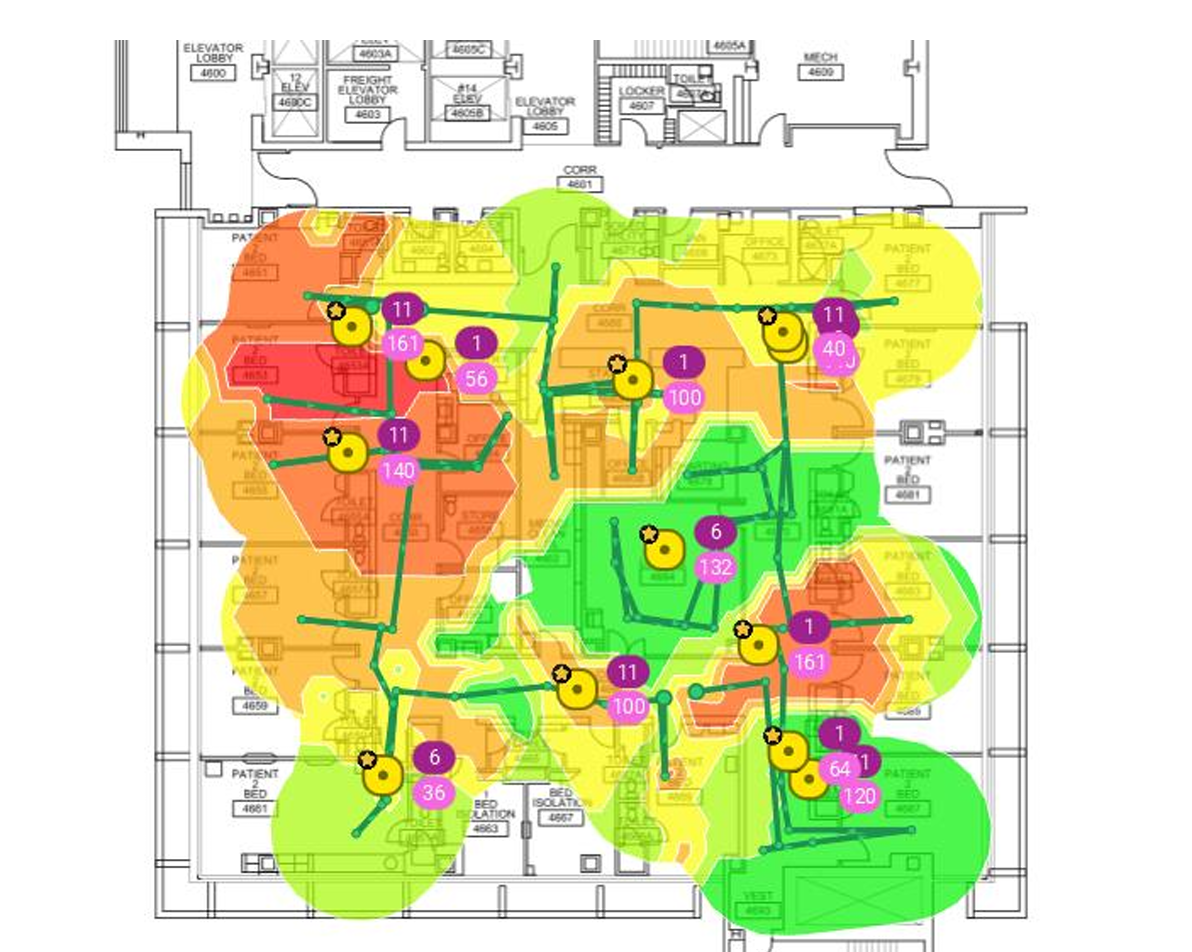
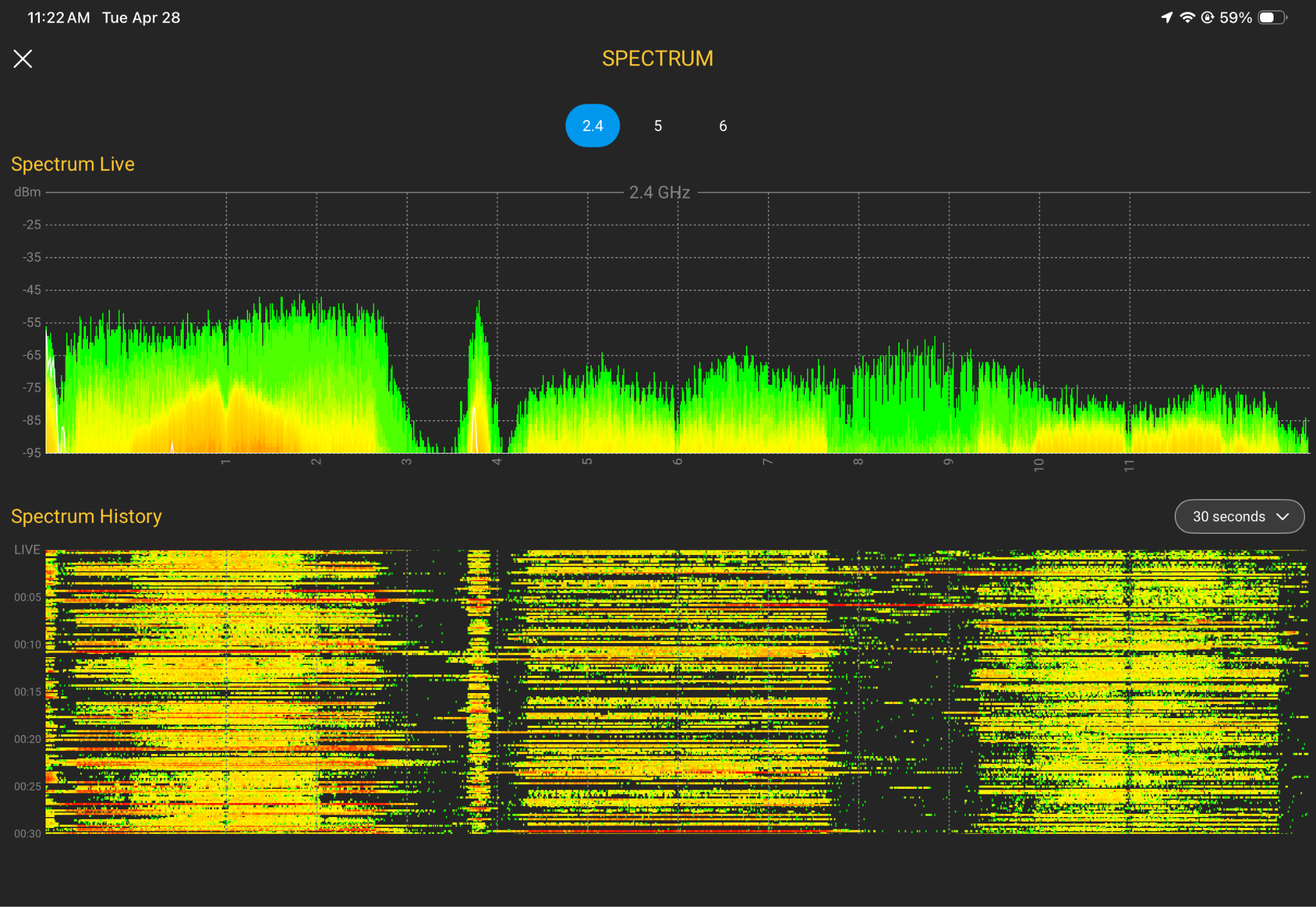
The existing design leaned heavily on 2.4 GHz. Co-channel interference on the non-overlapping channels — 1, 6, and 11 — was widespread. Patient-room devices added to the noise floor: wireless cameras and Bluetooth peripherals pushed utilization higher than a predictive model alone would suggest.
On 5 GHz, the deployment used a 20 MHz channel plan across the available spectrum, which was the right channel width for density — but co-channel interference still appeared, especially around commonly defaulted channels such as 36 and 100. In several areas, transmit power was set higher than necessary, which can hide placement problems until you walk the floor with a spectrum analyzer in hand.
My colleague gathered survey data and synced heatmaps through the cloud so I could review captures in parallel. On the inpatient floors, the walk data showed APs clustered along corridors while adjacent patient rooms fell into weaker coverage zones — a pattern that is easy to miss if you only validate from the hallway:
I carried a spectrum analyzer for spot checks whenever utilization spiked. One stand-out source was a portable wireless patient-monitoring camera saturating much of the 2.4 GHz band in its vicinity:
After several hours in the main tower, we moved to a separate surgical suite outside the primary building. There we documented asymmetric configurations, access points concentrated in corridors with weaker in-room coverage, elevated 5 GHz transmit power, and the same 2.4 GHz co-channel patterns repeated in spaces where reliability matters most — including areas adjacent to operating rooms.
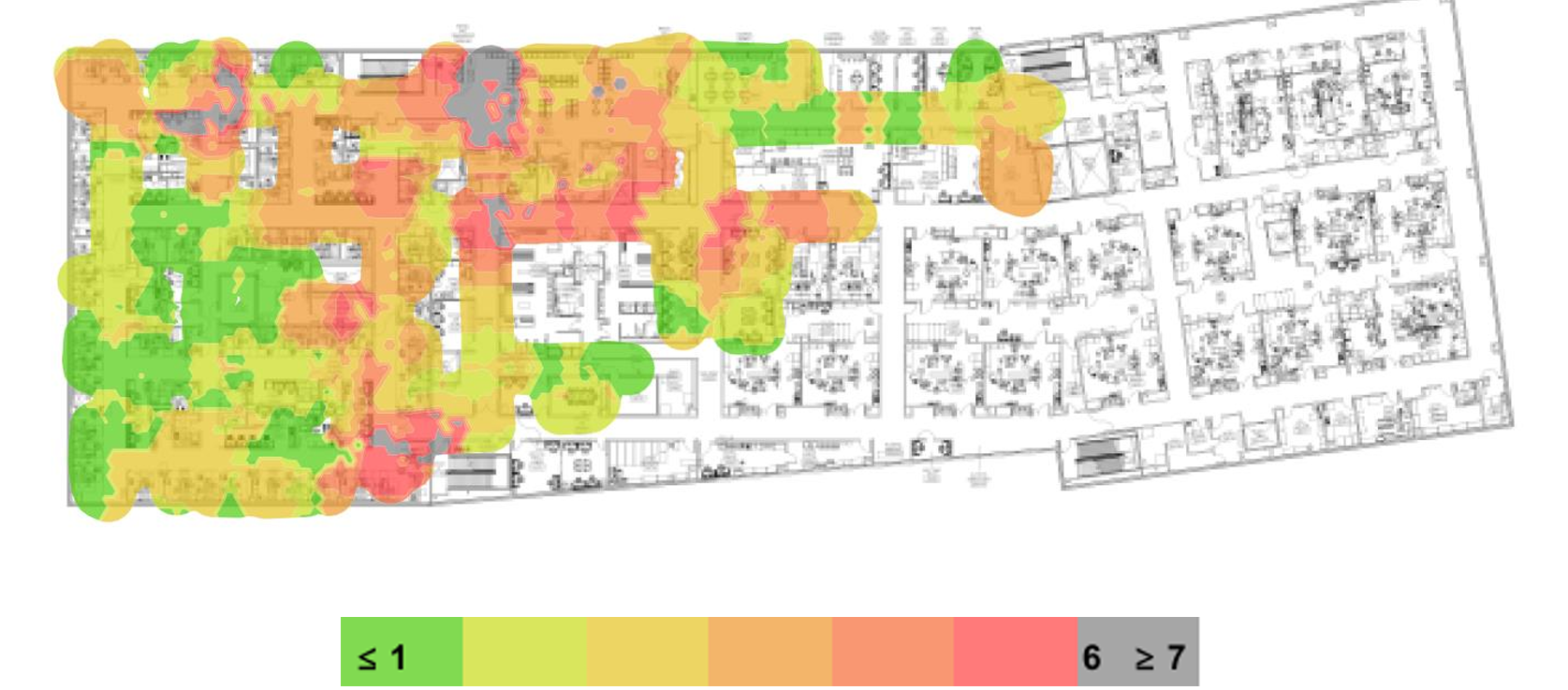
In those zones, clinical staff depend on voice-grade Wi-Fi rather than personal cell phones. Seeing heavy 2.4 GHz contention that close to critical workflows drove home why survey discipline matters. The heatmap is only as honest as the walk paths and the time you spend in the rooms people actually use.
How the situation de-escalated
Pressure eased once we moved from field notes to a structured report: clear findings, spectrum evidence, and prioritized recommendations the onsite team could act on. My colleague’s experience showed in how the data was captured and presented — every claim backed by survey output, not opinion.
I left with a sharper respect for hospital RF — not because the environment was simple, but because it was exactly the kind of complexity that rewards methodical survey work and calm execution under time pressure.
That assessment was the first of several healthcare wireless engagements I expect to be part of. More than any lab exercise, it taught me that walking the floors — with patience and attention to the people moving through them — is as important as reading the colors on a heatmap.
Details from this engagement have been generalized to protect client confidentiality. No employer, facility, or vendor is named.
Questions about hospital wireless surveys or RF troubleshooting? Get in touch.